
The question: how much more data can DDR5 move than DDR4?
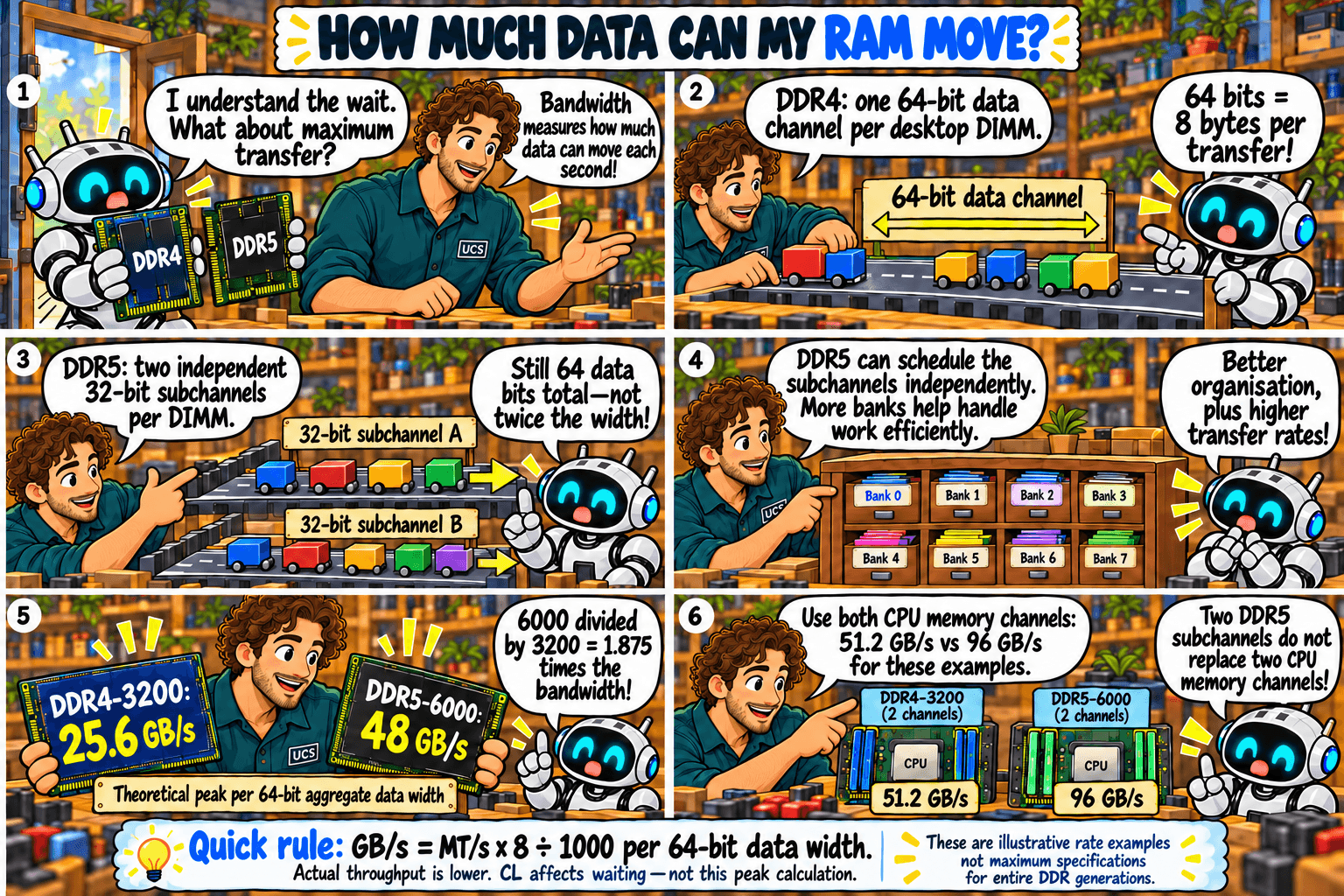
Quick rule: peak GB/s = MT/s × 8 ÷ 1,000 for each 64-bit memory channel.
Common mistake: assuming DDR5’s two subchannels double the data width or replace dual-channel installation.
What it means
Bandwidth is how much data memory can move each second. Each transfer on a 64-bit channel moves 8 bytes.
| Kit | One channel | Two channels |
|---|---|---|
| DDR4-3200 | 25.6 GB/s | 51.2 GB/s |
| DDR5-6000 | 48 GB/s | 96 GB/s |
- The ratio follows the transfer rate. 6,000 ÷ 3,200 = 1.875 times the peak bandwidth.
- At the same MT/s, DDR4 and DDR5 have the same calculated peak.
- DDR5 splits each module into two 32-bit subchannels. The total is still 64 bits, so bandwidth does not double and you still need modules in both CPU memory channels.
- These are peak figures for example kits. Real throughput is lower, and CL plays no part in the calculation.
What to check
- The rated MT/s and the MT/s your system is running at.
- That both CPU memory channels are populated.
- Measured bandwidth, and whether your workload needs it.
Not sure what fits? Send us your computer model and what you use it for. We check compatibility before you buy.
Ask us to checkSources
General guidance. Check the documentation for your exact hardware before you buy. Full notice.