
The question: why can two kits with the same CAS delay behave differently?
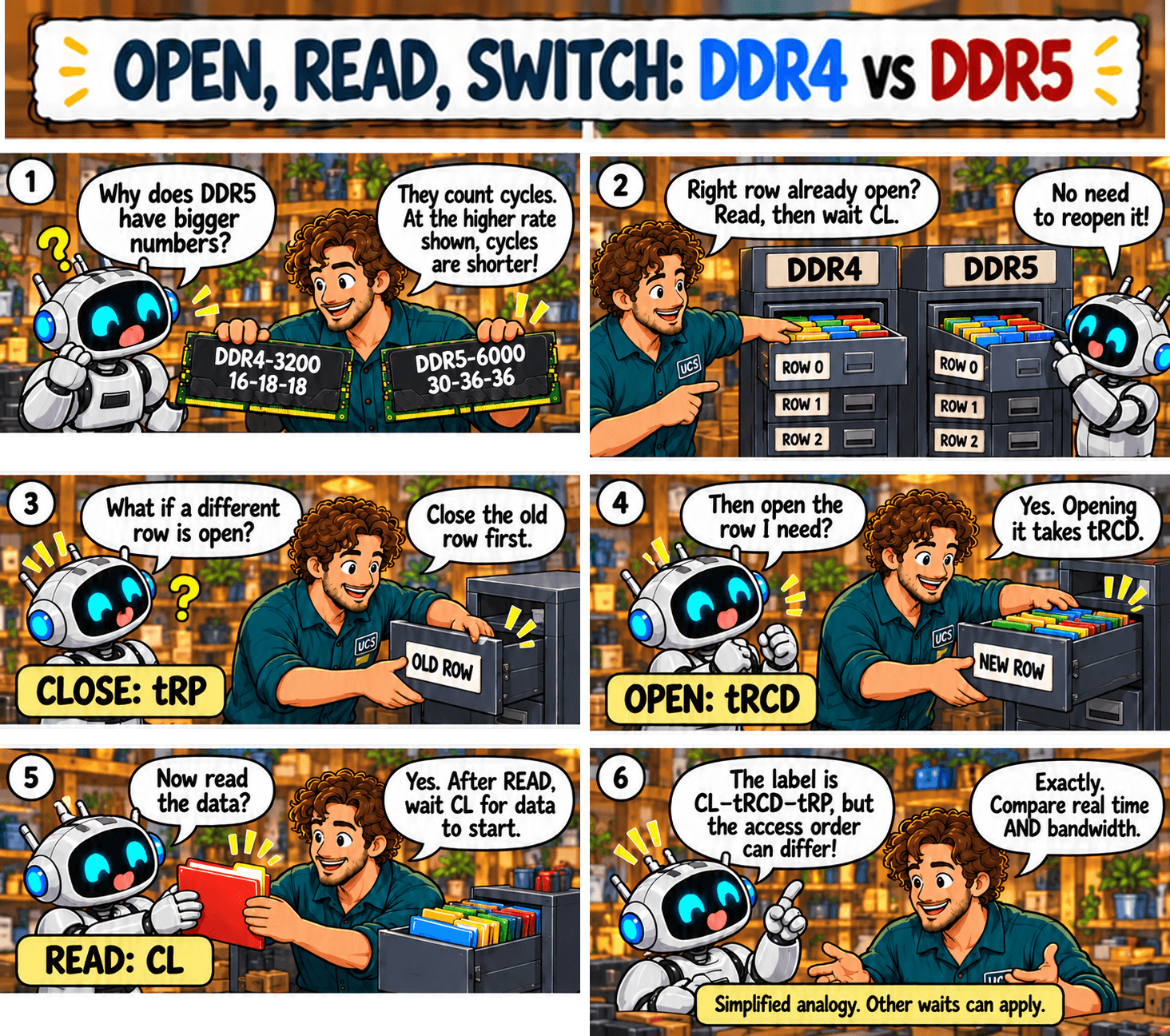
Quick rule: CAS delay is one of three waits. Compare CL, tRCD and tRP in nanoseconds.
Common mistake: treating CAS delay as the whole memory access time.
What it means
Think of memory as a filing cabinet, where each row of data is a drawer:
- The right drawer is already open: read the data. The wait is CL.
- The drawer is closed: open it first (tRCD), then read (CL).
- A different drawer is open: close it (tRP), open the right one (tRCD), then read (CL).
| Kit | CL | tRCD | tRP |
|---|---|---|---|
| DDR4-3200 CL16-18-18 | 10 ns | 11.25 ns | 11.25 ns |
| DDR5-6000 CL30-36-36 | 10 ns | 12 ns | 12 ns |
Both kits have a 10 ns CAS delay, but the DDR5 kit takes slightly longer to open or close a row. Not every read pays all three waits. These figures leave out delays in the CPU and memory controller.
The calculator in Episode 5 converts all three timings to nanoseconds.
What to check
- CL, tRCD and tRP, not CL alone.
- How your applications use memory. Some reuse open rows, some jump between them.
- Measured total latency.
Not sure what fits? Send us your computer model and what you use it for. We check compatibility before you buy.
Ask us to checkSources
General guidance. Check the documentation for your exact hardware before you buy. Full notice.